BaSIL Badge
“An open-source, wearable social radar that points to your friends—no screens, no cloud, no surveillance.”
1. The Concept: The Social Compass
BaSIL (Badge Social Irisé Libre) is a screenless wearable badge that uses light and subtle feedback to indicate the direction and distance of nearby trusted contacts. Think of it as a compass that always points toward your people.
- Zero-Screen Interface: Two concentric LED rings (16 + 8 WS2812B) provide directional and relational feedback through color, position, and animation patterns.
- Privacy by Design: No GPS tracking. No cloud. No persistent identity. Encryption keys and contact data are automatically purged after 72 hours without contact, or after a user-defined date (anti-stalking by design).
2. Technical Architecture & Evolution
The project started with a proof of concept (PoC) on an ESP32-C6, which was quickly set aside in favor of a more frugal and industrial architecture.
- V1 (Current Version) – The BLE/LoRa Core: Transition to the Nordic nRF54L15 microcontroller to leverage Bluetooth 6.0 (Channel Sounding) and measure distances (< 100m) with centimeter precision. Long-range connectivity (> 100m) is handled by a LoRa network via the Wio-SX1262 module.
- V2 (In Development) – RF & Textile R&D: Planned transition to the LR2021 transceiver (FLRC, 2.6 Mbps) and integration of “neck loop” style textile antennas (embroidery, flex PCB).
- V3 (Future Vision) – Modularity: Adding standardized pogo pin connectors to attach add-on modules (GPS, speaker, screen, extended battery) without modifying the core system.
3. Prototyping & “Core + Shell” Philosophy
BaSIL is an open-hardware platform designed with a strict separation of roles:
- The Core (Standardized): A robust PCB housing independently available components (MCU, Radio, QMC5883L Magnetometer, TTP223 capacitive touch button). The LiPo battery (504040) is hot-swappable to extend field autonomy.
- The Shell (Free): Dressing the badge is left to the user (CAD, 3D printing, biomaterials). Like a lightsaber, each badge reflects its maker. The current iteration uses temporary polypropylene enclosures (like Muji cosmetic boxes) for their excellent light diffusion, before finalizing the design on a dedicated enclosure.
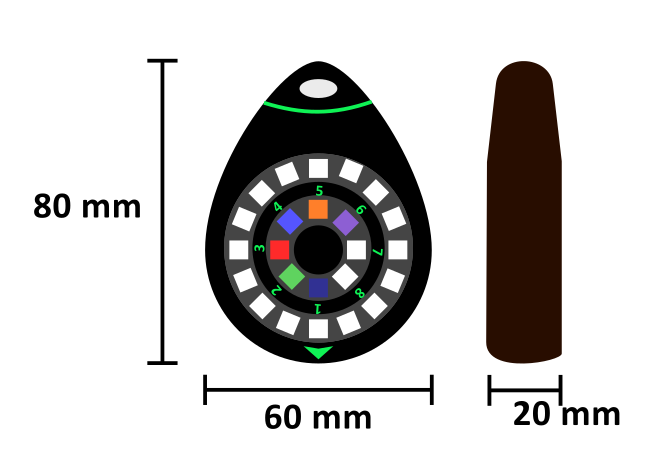
Mock-up visualization of the finished product, with markings reminiscent of 90s watches.
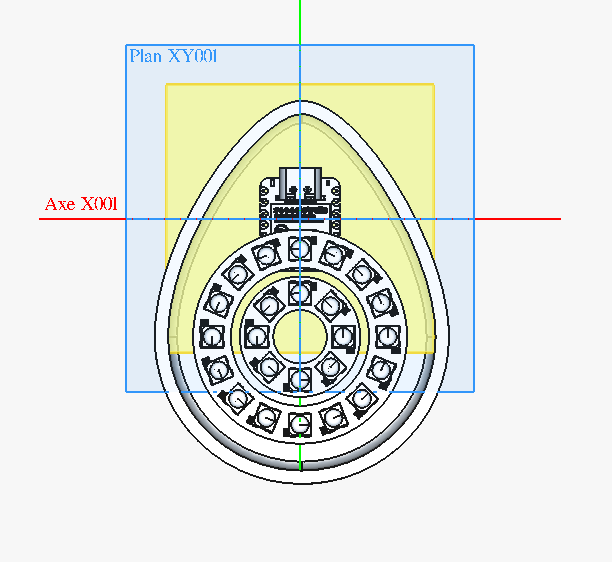
Top-down CAD view of the project enclosure, featuring the LED rings and the Xiao module.

Angled CAD view of the project enclosure.
4. Roadmap & Open-Source Model
Beyond live events (festivals, conventions), this project explores the concept of local digital sovereignty (off-grid hiking, bike fleet tracking, treasure hunts).
- Current phase: PCB routing for V1 (KiCad) and validation of the enclosure’s mechanical integration.
- Next step: RF propagation testing on the “neck loop” antenna (V2) and refinement of filtering algorithms (Kalman) and TinyML for environmental classification.
- Open-Source Release: The Git repository (Zephyr sources, hardware schematics, 3D files) will be made public under a hybrid licensing model tailored for makers.
For more information, you will soon be able to follow this project’s Git repository once V1 is validated.
Skills
Hard Skills
- Real-Time Embedded Systems: Zephyr RTOS architecture (Devicetree, Kconfig, power management).
- Next-Generation Protocols: Early implementation of BLE 6.0 (Channel Sounding), NFC, LoRa Mesh, and LoRa+.
- Mathematics & AI: AHRS algorithms (Sensor Fusion) using triangulation and trilateration, as well as Edge AI deployment (TinyML / Neuton.AI).
- Hardware Design: Balancing physical constraints (antenna management and radio interference / autonomy / portability). PCB creation via KiCAD and the use of FreeCAD.
Soft Skills
- Inclusive Design (UX): Designing accessible and non-intrusive “Head-up” human-machine interfaces.
- Agility & Autonomy: Rapid onboarding within the Nordic/Zephyr industrial ecosystem.
- Innovation Ethics: Low-Tech philosophy, repairability, and Privacy-by-design.