Citrus Biomaterial
“Exploring citrus by-products for material creation and pigment extraction.”
The Concept: From Food Waste to Resource
This project explores the potential of citrus peels (clementines, mandarins, bergamots) as a raw material for design and craftsmanship. The idea is to upcycle these often-discarded by-products by experimenting with molding, drying, and pigment extraction techniques.
This work aligns with a frugal design and circular economy approach, while also exploring “partially lost knowledge” by drawing inspiration from the 18th-century upcycling of citrus peels, such as the traditional craftsmanship of bergamot peel boxes.
Experiment 1: Molding Clementine Peels
The goal was to replicate the small bergamot boxes using clementine peels. The technique involves molding the peel by pressing it onto forms (like the bottoms of glasses or small bottles) during the drying process, making it conform to the shape of the mold.
This molding process proved to be extremely simple and advantageous. As it dries, the mandarin/clementine peel forms a very thin and light pseudo “plastic-cardboard.” While its thinness defines and limits certain structural uses, it opens the door to other applications. A key challenge identified for the future is optimizing the usable surface area: understanding the fiber structure allows for mechanical processes (tension, softening through humidification) to stretch and utilize the peel over the largest possible area.

Molding and drying clementine peels on glass supports.
Experiment 2: Pigment Extraction
Concurrently with the molding research, I conducted a chemical exploration phase by turning peels into powder to extract their pigments.
Using isopropanol as a solvent/eluent, I successfully extracted the coloring compounds from the clementine powder. The extraction targets carotenoids (the molecules responsible for orange/yellow colors in citrus and other plants).
The isopropanol-based pigmented solution (visible in the small clear bottle) opens up possibilities for creative reappropriation. In fact, this natural pigment has already been successfully tested and used as an alcohol ink by a member of the Noir Pastel collective for graphic creations. Although not currently planned, it could be fun to perform chromatography to visually separate and identify the different extracted pigments.
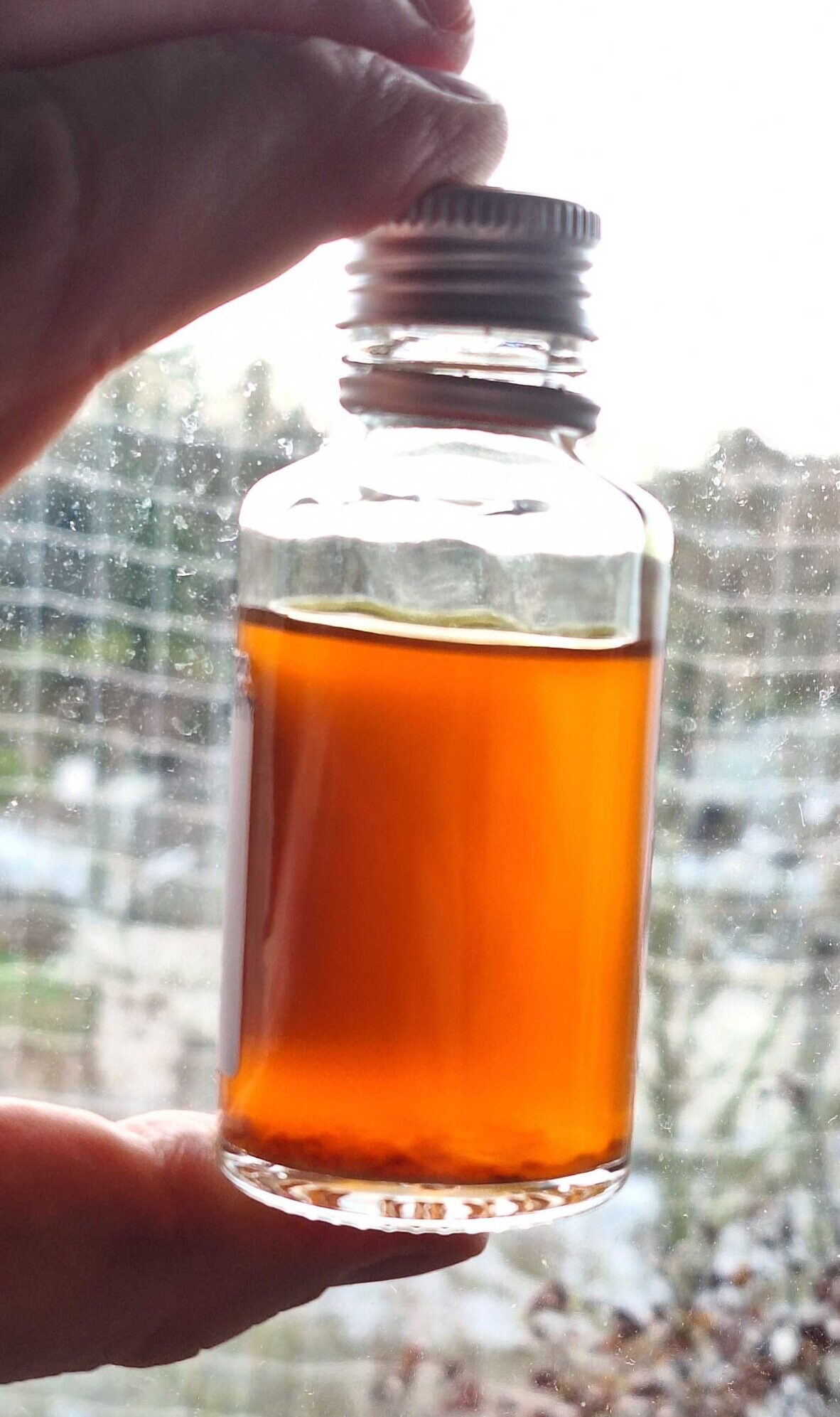
Extracting carotenoids from clementine powder using isopropanol.
Applied Skills
The project involved applying technical skills in a constrained and frugal exploratory environment (DIY/Kitchen Homelab).
Hard Skills
- Frugal Chemistry & R&D: Adapting solvent extraction protocols (isopropanol) outside of a classic laboratory and understanding the chemistry of natural pigments (carotenoids).
- Material Design & Engineering: Understanding plant fiber structure for surface area optimization (tension, humidification) and mastering frugal organic molding techniques.
Soft Skills
- Holistic Curiosity: The ability to simultaneously pursue complementary R&D tracks (the mechanical properties of molding vs. the chemical properties of pigments) on the same raw material.